Circular: a marketplace for college students
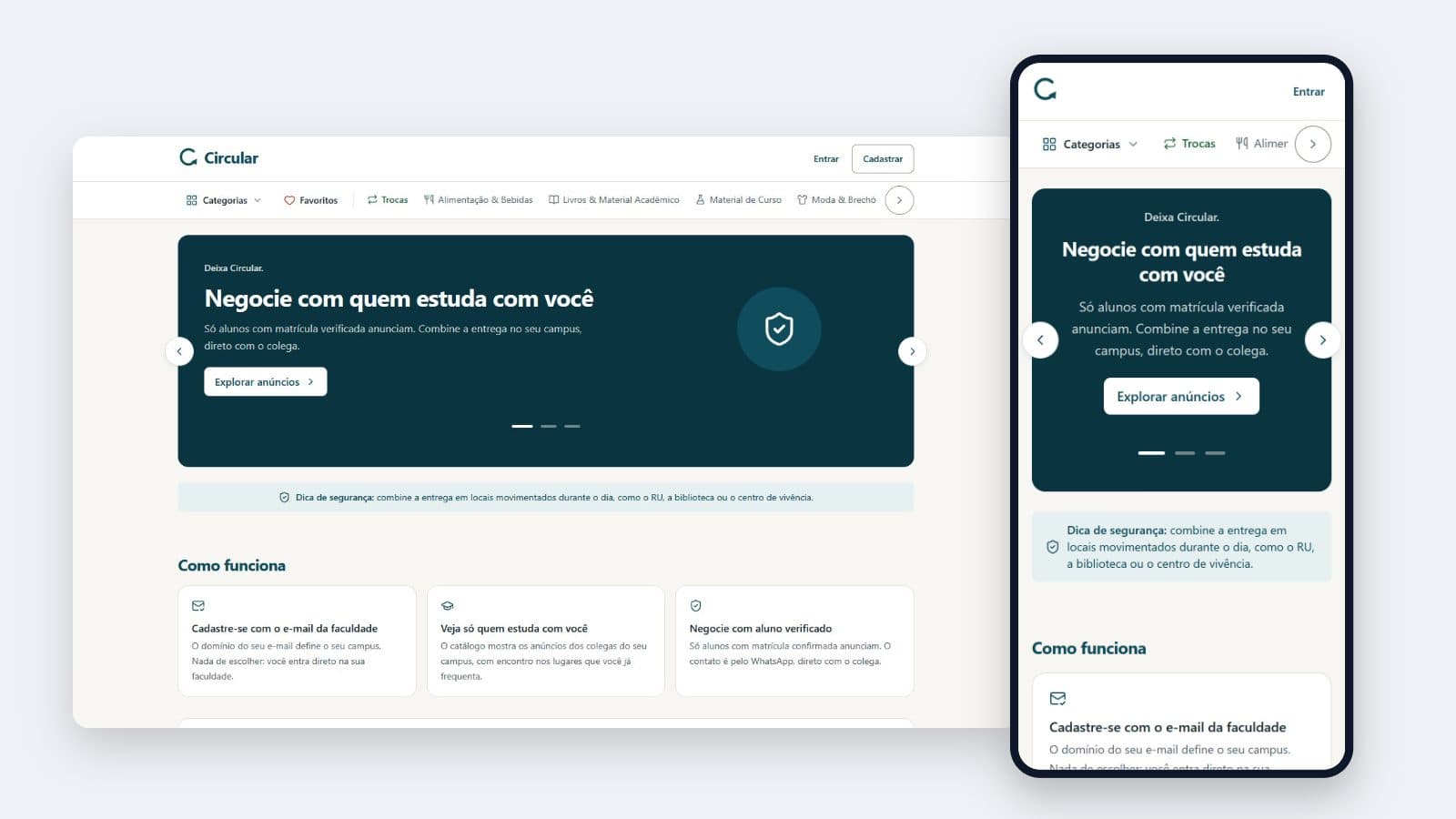
A product of my own, from idea to launch: a marketplace where only verified students post listings and trade with classmates on the same campus, meeting up at school to hand things over.
- My role
- Product creator: Product Owner, design and AI-assisted development
- Period
- 2026 – present
- Client
- Personal project
Context and problem
In college, a lot changes hands between students: books, lab coats, course materials, electronics, homemade food. It happens in WhatsApp groups and on social media profiles, without knowing who is on the other side and without one place to find what you need.
Existing options don't fit this case well:
- Open marketplaces pull in the whole city. You don't know if the seller goes to your school, and the meetup can happen anywhere.
- WhatsApp groups feel trustworthy, but a post disappears in the conversation within hours and nothing is searchable.
Circular combines both: the trust of dealing with a classmate and the organization of a catalog. Only verified students post listings, each student sees listings from their own campus, and the handover happens at school, in places both people already go.
My role
It's my own product, end to end:
- defining the problem, the audience and the MVP scope;
- all of the design, including the design system;
- AI-assisted development: a Next.js front end and a Supabase back end (authentication, a database with per-user access rules and image storage);
- transactional emails, analytics (GA4) and deployment on Vercel;
- terms of use, privacy policy and the launch plan.
From Mercadinho to Circular
The project started in April 2026 as Mercadinho Universitário ("college mini-market"), an assignment for a college course: a space for students who sell food and products at school to open a "store". Each store went through manual approval, and an admin checked each student's enrollment.
After the course, I decided to turn the assignment into a real product. Rethinking the idea for an actual launch surfaced two problems:
- Manual approval doesn't scale. Every new student depended on someone checking documents, which blocks growth right when you need it most: at launch.
- The store format was too narrow. Most of what moves between students doesn't come from people who "have a store", but from people who want to pass on a book or a lab coat.
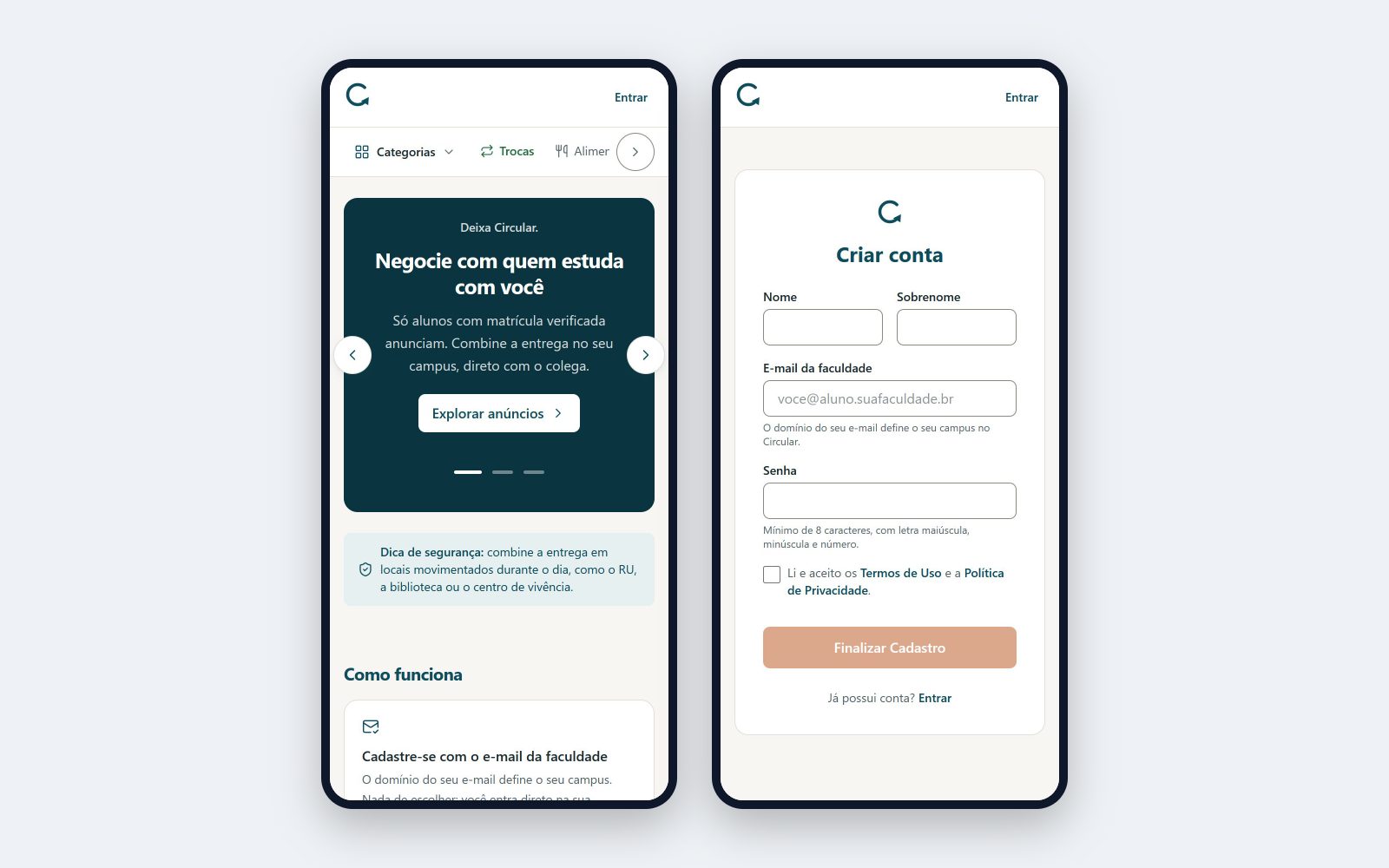
In October 2026, the product became Circular: any verified student can post, to sell or to trade, and the brand started talking about a community economy ("Deixa Circular.", roughly "let it circulate"). A new design system came with it: its own palette, Plus Jakarta Sans, thin-stroke icons, no emojis and 44px touch targets.
Key decisions
Decision
How do you make sure only students use the platform?
Options considered
- Manual validation: students upload proof of enrollment and an admin approves it.
- Sign-up with a school email: the email domain identifies the college and campus.
Criteria
Verification is the product's core promise, but it can't depend on a person approving sign-ups. A student who signs up and waits days to get in doesn't come back.
Choice
Sign-up with the school email. The domain sets the campus automatically, with nothing for the student to pick, and confirming the email proves enrollment. Changing the email changes the campus.
Trade-off
Only colleges that give students an institutional email can join, and each new school has to be registered with its domains.
Decision
Should the catalog be open or limited to the campus?
Options considered
- A public catalog open to any visitor, good for SEO and for attracting people.
- A catalog for registered students only, showing only listings from their own campus.
Criteria
Circular's edge is trading with people who study with you. An open catalog mixes distant campuses, exposes students' data to anyone and becomes an easy scraping target.
Choice
The catalog is only visible when logged in and shows only your own campus. Profiles of students from other campuses open in read-only mode. The public home page explains the product and leads to sign-up.
Trade-off
I give up organic traffic from listings and a storefront for people who haven't signed up yet. In return, the "classmates only" promise is real and students' data stays protected.
Decision
How do buyers and sellers talk and close the deal?
Options considered
- A checkout with payments handled by the platform.
- A built-in chat.
- Direct contact on WhatsApp.
Criteria
Students already negotiate on WhatsApp and settle payment between themselves at the handover. Handling payments brings cost, liability and bureaucracy an MVP doesn't need. A built-in chat is expensive to build and moderate, and makes students open yet another app.
Choice
Contact happens on WhatsApp, for logged-in students only. A WhatsApp number is required to post a listing, and every "I'm interested" click is tracked as a metric, since the sale itself happens off the platform.
Trade-off
The platform doesn't know whether a sale closed and can't mediate problems. To compensate, sellers mark listings as sold, users can be reported and blocked, and the home page shows safety tips for meetups, such as meeting in busy spots on campus.
Decision
How long should a listing stay up?
Options considered
- No limit, until the seller removes it.
- 30 days.
- 60 days.
Criteria
Abandoned listings are the biggest risk for a small marketplace: a student reaches out, nobody answers, and they don't come back. On the other hand, with few listings at launch, a deadline that's too short empties the catalog.
Choice
60 days. That covers about two months of classes and still clears out forgotten listings.
Trade-off
Some outdated listings may stay up longer. The sold status and seller-side renewal reduce that effect.
Security and privacy
Because it handles student data, security and LGPD (Brazil's data protection law) compliance were part of the MVP, not a later phase:
- database access rules, so each student can only see and change what they're allowed to;
- seller contact details available only to logged-in students;
- uploads limited to small images;
- terms of use, a privacy policy and self-service account deletion;
- a round of security testing before launch, with the fixes applied.
Results
- Product live, with sign-up, a per-campus catalog, favorites, trades and a student dashboard.
- From course assignment to product in about six months, built by one person with AI assistance.
- The launch is just starting. There are no usage numbers to show yet.
Next steps
- Launch and track the first metrics: sign-ups, published listings and interest clicks.
- Business model: still being defined. One hypothesis is paid boosts for listings.
- Other ideas under evaluation: a donation mode and a built-in chat, if WhatsApp stops being enough.
Learnings
- Get the human bottleneck out of the way. Manual approval felt safer, but it held the product back. The institutional email delivers the same trust with nobody in the middle.
- Use what your audience already uses. WhatsApp isn't the most elegant solution, but it's where students already negotiate. Building a chat before having users would be solving the wrong problem.
- With AI, one person can build a whole product. The challenge shifts from writing code to deciding what to build, what to leave out and how to keep it all secure.